Are sausages gluten-free? A UK guide to rusk, labels and cross-contamination
Some UK sausages contain wheat rusk and some don't. How to check the label, what to ask at the butcher's counter, and how to avoid cross-contamination.
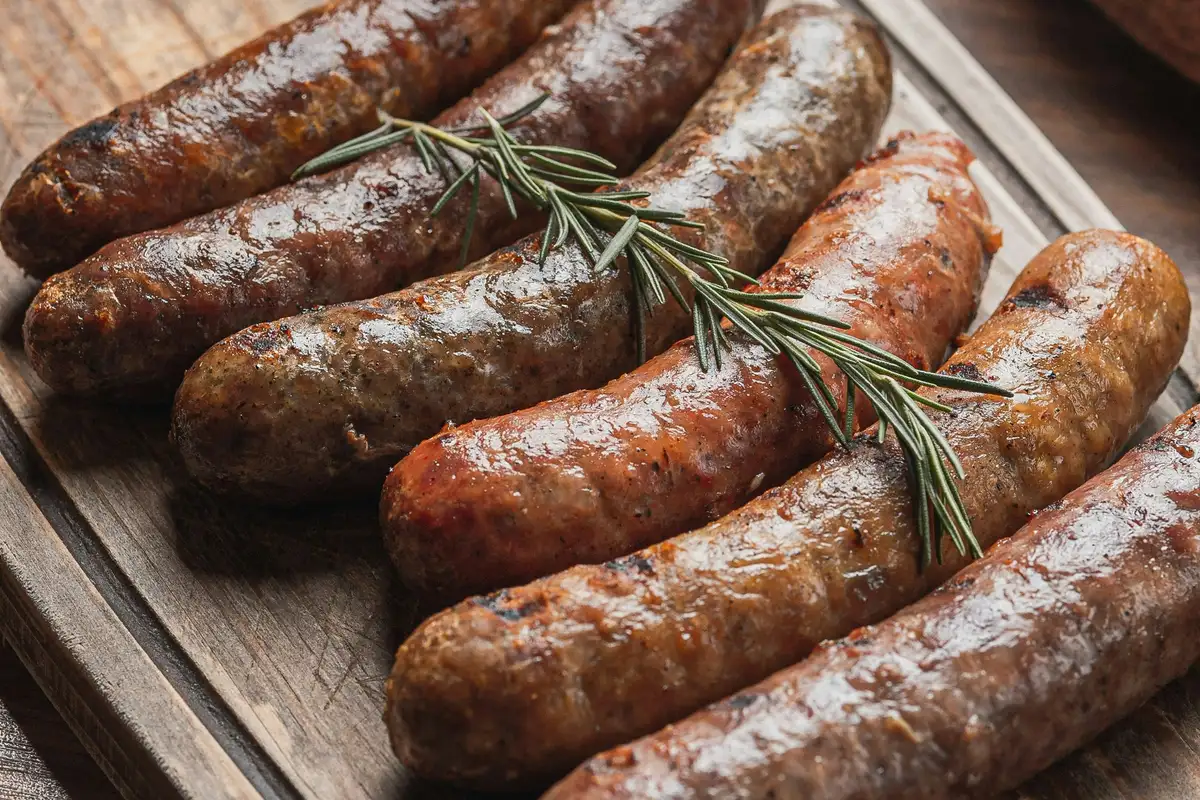
Sausages turn up in so many British meals: a fry-up, sausage and mash, a barbecue, pigs in blankets at Christmas. Plain meat is naturally gluten-free, and the NHS lists meat and fish (although not breaded or battered) among the foods you can eat with coeliac disease. A sausage is different, because of what goes into it alongside the meat, and how it’s handled and cooked.
The short answer
Some sausages are gluten-free and some aren’t, and you can’t tell by looking. Coeliac UK’s gluten-free checklist puts sausages, burgers, meat pastes and patés, and meat or poultry marinated or in a sauce in its “need to check” column. Coeliac UK also names processed foods like sausages as somewhere gluten turns up.
Two separate questions decide whether a sausage is suitable:
- What’s in it? The ingredients and allergen information tell you whether gluten is part of the recipe.
- Could gluten have got onto it? Shared equipment, grills, fryers and utensils can transfer gluten to a sausage that contains none. This is cross-contamination (sometimes called cross-contact).
Gluten-free sausages do exist (the Cumberland sausage specification below even allows for them), so this is about checking rather than going without.
Why some sausages contain gluten: rusk and other ingredients
Rusk is a traditional ingredient in British sausages. UK labelling law describes rusk as a “crumbed baked cereal product”, and traditional rusk is often made from wheat. But rusk isn’t one fixed recipe, and not every sausage contains wheat.
The UK’s protected-name specification for Traditional Cumberland Sausage shows how much it can vary even within one type of sausage. It says the rusk “can include wheat based dough, potato starch, flaked rice, spelt, soya grit and gluten free rusk”, and that “Gluten free rusk may also be used if a gluten free sausage is required”. That is one specification for one sausage, not a rule for all sausages, but it makes the point: two sausages that look identical can be made quite differently. Only the ingredients, the allergen information and how it was made tell you whether a particular sausage is suitable.
Things to know when you read the ingredients:
- “Rusk” on its own doesn’t tell you. By law, if an ingredient comes from a cereal containing gluten, the cereal must be named and emphasised in the ingredients list. So look for the cereal in bold, for example “rusk (wheat flour, …)”.
- Spelt is wheat. UK allergen law lists wheat “such as spelt and khorasan wheat” among the cereals containing gluten. A sausage made with spelt rusk is not gluten-free.
- Rusk isn’t the only possible source. A cereal containing gluten may also be in a coating, a seasoning or a sauce. Coeliac UK says that even if only a tiny amount is used, it must still be listed.
- Breadcrumbs and batter contain gluten unless they are labelled gluten-free. Coeliac UK lists meat cooked in batter or breadcrumbs as not gluten-free unless labelled gluten-free, and lists breadcrumbs and batter mixes as not gluten-free.
Gluten in the ingredients vs cross-contamination
These are two different risks, and they’re checked in different ways:
| What to know | Gluten as an ingredient | Gluten from cross-contamination |
|---|---|---|
| What it means | Wheat, barley, rye or oats (or something made from them, such as wheat rusk) is part of the recipe | Gluten gets onto the food by accident, from shared equipment, surfaces, oil or utensils |
| On a pack | Must be in the ingredients list, with the cereal emphasised, usually in bold | May be shown as a “may contain” warning, but these warnings are voluntary, so their absence is not a guarantee |
| Loose food, cafés and takeaways | The business must tell you about it if you ask, verbally or in writing | Ask how the food is prepared and cooked |
| Where it happens with sausages | Wheat rusk, breadcrumb coatings, batter, some seasonings and sauces | Shared mincers and mixers, counters, tongs, grills, fryers and toasters |
| What helps | A gluten-free claim, or reading the ingredients every time | Separate or thoroughly cleaned equipment, a clean grill or pan, separate utensils |
Sources for the table: Coeliac UK’s label guide, GOV.UK guidance on allergen labelling and precautionary allergen labelling, and the Food Standards Agency’s guidance on precautionary allergen labelling, which lists shared equipment and sharing utensils without thorough washing among the ways allergens get into food.
The NHS puts it simply: cross-contamination can happen “if gluten-free foods and foods that contain gluten are prepared together or served with the same utensils”. And heat doesn’t fix it: the Food Standards Agency notes that cooking and other processing “does not consistently destroy food allergens”.
How to read a sausage label
- Look for a gluten-free claim. In the UK, “gluten-free” can only be used where the food as sold contains no more than 20 mg/kg of gluten. The limit applies to the food as sold, so it covers any gluten picked up during manufacture, not just the recipe.
- No claim? Read the ingredients for cereals in bold. Cereals containing gluten must be emphasised in the ingredients list, usually in bold. On a sausage, they may be in the rusk, a coating or the seasoning.
- Check for “may contain” warnings. If a product has no gluten-free claim, Coeliac UK’s checklist advises making sure there is no “may contain” statement for cereals containing gluten, and if there is one, it advises you don’t eat it. Our guide to gluten-free vs “may contain” labelling explains how these warnings work.
- Check every time. Coeliac UK’s label guide reminds you that “recipes and manufacturing processes can change without warning”.
Burgers, pigs in blankets, Scotch eggs and other meat products
The same checks apply to a wider group of foods. This summary follows Coeliac UK’s checklist:
| Food | Coeliac UK checklist | What to check |
|---|---|---|
| Fresh meat and poultry, plain cooked, cured and smoked meats | Gluten-free | Nothing added? Then it’s naturally gluten-free (cross-contamination can still happen when it’s prepared or cooked) |
| Sausages and burgers | Need to check | A gluten-free claim, or cereals in bold (often in the rusk) |
| Pigs in blankets | Need to check (sausages) | The sausage label, and the bacon if it’s glazed, marinated or in a sauce |
| Meat or poultry marinated or in a sauce | Need to check | The marinade or sauce, which may use flour or soy sauce |
| Meat pastes and patés | Need to check | A gluten-free claim, or cereals in bold |
| Vegetarian and vegan sausages, vegetable and bean burgers | Need to check | A gluten-free claim, or cereals in bold (including oats) |
| Breaded ham, faggots, haggis, rissoles | Not gluten-free unless labelled gluten-free | Only choose versions labelled gluten-free |
| Meat in batter or breadcrumbs (such as battered sausages) | Not gluten-free unless labelled gluten-free | Only choose versions labelled gluten-free |
| Scotch eggs | Not gluten-free | Don’t assume. Only choose one labelled gluten-free, and read the ingredients |
Scotch eggs need two things to be gluten-free: the sausage meat and the coating. Conventional breadcrumbs often contain wheat, and Coeliac UK lists breadcrumbs as not gluten-free. So look for a Scotch egg that is explicitly labelled gluten-free, check the ingredients for cereals in bold, and if it’s sold loose, ask about both the ingredients and how it was cooked.
Sausage rolls and toad in the hole depend on the pastry and the batter as well as the sausage. Coeliac UK lists pastries made from wheat flour, and batter mixes, as not gluten-free. A homemade version needs gluten-free sausages and a gluten-free pastry or flour.
For marinades, our soy sauce guide explains why soy sauce is a common source of wheat. If you’re serving sausage and mash, see our guide to gravy granules and stock cubes too.
At the butcher’s or deli counter
Sausages and burgers from a butcher’s counter are labelled differently from supermarket packs, but you’re still entitled to the allergen information. GOV.UK explains how this works:
- Packed on site before you choose them (GOV.UK gives “burgers packed on site at a butchers” as an example): these are “prepacked for direct sale” and must have a full ingredients list with allergens emphasised.
- Loose, or wrapped when you ask: the business must give you allergen information for any of the 14 allergens, including cereals containing gluten. This can be given verbally or in writing, and if it’s verbal, they must tell you where you can find written confirmation.
That covers the ingredients. Cross-contamination is a separate question, and a butcher’s counter has several places where it can happen: sausages with and without wheat rusk may be made with the same mincer, mixer and filling equipment, displayed side by side, and picked up with the same tongs. Rusk is a dry crumb, so how it’s stored and handled matters too. Useful questions to ask:
- “Are these labelled gluten-free?” A gluten-free claim has the same legal meaning as on a supermarket pack: no more than 20 mg/kg of gluten.
- “Are they made here? What’s used as the rusk or binder?”
- “How are the gluten-free sausages kept separate?” For example: are they made on separate equipment, or after a full clean? Are they kept apart in the counter and served with separate tongs? GOV.UK says businesses making “free-from” claims “must follow strict processes to prevent cross-contamination”, and if they can’t remove the risk, they should tell you and not make the claim.
- “Is there a ‘may contain’ warning for these?” GOV.UK’s guidance for businesses says a precautionary allergen warning doesn’t have to be on a label: it can be given verbally by staff or on a sign.
If the answers don’t reassure you, choose something else, or choose sausages that are labelled gluten-free and packed before they reach the counter.
Barbecues
At a barbecue, the sausages and burgers are only half the story. A gluten-free sausage can pick up gluten from a grill that has just cooked ordinary sausages or toasted buns, and from shared tongs. Coeliac UK’s catering guidance, written for kitchens but useful at home, says:
- Grill: “a clean grill should be used to grill gluten free foods”, with a separate griddle or a dedicated area, and “where this is not possible, a clean pan can be used instead”
- Basting: use separate bastes and basting brushes for gluten-free food
- Utensils: use utensils that are clean or dedicated to gluten-free food, and separate, clean serving utensils
- Common mistakes include sharing utensils and equipment without cleaning them, and using the same grills and toasters for gluten-free food and food containing gluten
For cleaning, Coeliac UK’s cross-contamination advice is to clean pots, pans and utensils with hot soapy water. Don’t rely on the heat of the grill to deal with leftover residue: as the Food Standards Agency notes, heating doesn’t consistently destroy allergens.
Coeliac UK has also shared barbecue tips, published by the Chartered Institute of Environmental Health (we couldn’t find them on Coeliac UK’s own website). They suggest using clean foil or separate trays to create gluten-free zones on the grill, serving the gluten-free food first, and keeping ordinary buns away from the gluten-free food.
In practice, that means:
- Use a clean grill, a separate tray or clean foil, or a clean pan for the gluten-free food. Cooking it first, on a freshly cleaned grill, makes this easier.
- Keep separate tongs, brushes and serving plates for the gluten-free food, and don’t let them wander.
- Check everything that goes on or with the sausages: the sausages themselves, marinades, sauces, seasonings and condiments. Coeliac UK lists meat marinated or in a sauce as “need to check”.
- Keep ordinary buns off the grill and away from the gluten-free food. Bread made from wheat, rye or barley isn’t gluten-free, so a gluten-free sausage needs a gluten-free bun, or none.
- Talk to whoever is cooking, so they know what you need before the first sausage goes on.
Our guide to cross-contamination at home covers shared toasters, spreads and fryers in more detail.
Eating out: cafés, pubs, takeaways and chip shops
A sausage on a café or pub menu needs the same two questions as a sausage in a shop: what’s in it, and how is it cooked?
Your right to allergen information. Restaurants, cafés and takeaways must tell you if any of the 14 allergens, including cereals containing gluten, are in their food. For loose food they can tell you verbally, but they must let you know where to find written confirmation. Takeaways must give you this information both before you buy and when the food is delivered. They don’t have to cook you something different, though.
The cooking matters as much as the ingredients. In a café kitchen, sausages may share a grill or griddle with other foods, a fryer with battered or breaded foods, and a toaster or grill with ordinary bread. Coeliac UK’s catering advice says kitchens should use a dedicated grill or part of the grill, a dedicated, clean fryer with clean oil, and a dedicated toaster or toaster bags for gluten-free food. The Food Standards Agency’s guidance for businesses gives the example that gluten-free chips can’t be cooked in oil previously used for battered fish.
Questions to ask, based on GOV.UK and Coeliac UK’s eating out tips:
- “Are your sausages gluten-free, or do they contain wheat rusk?” (Ask about gluten-free, not just “no wheat”.)
- “How is food handled in the kitchen, and could my food be contaminated?”
- “Are they cooked on a clean grill or a separate part of it, or in a separate pan?”
- “Is the fryer shared with battered or breaded food?”
- “Have the ingredients changed recently?”
Coeliac UK suggests calling ahead to speak to a manager or chef, and says that if you’re still in any doubt that the meal is safe, don’t eat it.
In a chip shop, a battered sausage is not gluten-free unless the batter is gluten-free, and anything cooked in a shared fryer can pick up gluten. Our chips guide and malt vinegar guide have more on chip shops, and our eating out guide covers what to ask and your rights to allergen information.
At Christmas
Pigs in blankets are the Christmas version of the same question. Our gluten-free Christmas guide covers the whole Christmas table, including stuffing, gravy and keeping the roasting tins separate.
Quick checklist
- Does the pack say gluten-free? Suitable, as long as it isn’t cross-contaminated when you cook or serve it.
- No claim? Look for wheat, barley, rye, oats or spelt in bold. “Rusk” on its own doesn’t tell you. If a cereal containing gluten is there, or you can’t tell, leave it.
- “May contain” a cereal containing gluten, with no gluten-free claim? Coeliac UK advises not eating it.
- Breaded, battered, faggots, haggis or Scotch eggs? Only if labelled gluten-free.
- Butcher, café or barbecue? Ask about the ingredients and about the equipment: mincer, counter, tongs, grill and fryer.
For more everyday shopping tips, see our UK supermarket guide.
Frequently asked questions
Are sausages gluten-free in the UK?
Some are and some aren't. Coeliac UK lists sausages as a 'need to check' food: some are made with rusk or other ingredients that contain gluten, and some aren't. A sausage labelled gluten-free must meet the legal limit of 20 mg/kg of gluten. Without that claim, check the ingredients for wheat, barley, rye or oats in bold, and for a 'may contain' warning.
Is rusk in sausages gluten-free?
Not always. Rusk is a dried, crumbed cereal ingredient, and traditional rusk is often wheat-based. The UK specification for Traditional Cumberland Sausage allows rusk made from wheat-based dough, but also from potato starch, flaked rice, spelt (which is a type of wheat) or soya grit, or gluten-free rusk. The word 'rusk' alone doesn't tell you, so check whether a cereal containing gluten is in bold.
Are Scotch eggs gluten-free?
Don't assume so. Coeliac UK lists Scotch eggs as not gluten-free. Conventional breadcrumb coatings often contain wheat, and the sausage meat may contain gluten too. Only choose one that is explicitly labelled gluten-free, and still read the ingredients.
Are pigs in blankets gluten-free?
Only if the sausages are. Check the label for a gluten-free claim, or for wheat, barley, rye or oats in bold. Plain bacon is a cured meat, which Coeliac UK lists as gluten-free, but bacon that is glazed, marinated or in a sauce needs checking too.
Are burgers gluten-free?
Not automatically. Coeliac UK lists burgers, including vegetable and bean burgers, as 'need to check' foods. Check the label every time, and remember that the bun needs to be gluten-free as well.
Can a gluten-free sausage pick up gluten when it's cooked?
Yes. Cross-contamination can happen when gluten-free food is cooked on the same grill as food containing gluten, or handled with the same tongs or utensils. Coeliac UK's catering guidance says gluten-free food should be grilled on a clean grill or a separate, dedicated area, or in a clean pan. Heating does not reliably remove the risk.
Sources
- Gluten free checklist (May 2024), Coeliac UK. Accessed 8 October 2026.
- How to read food labels, Coeliac UK. Accessed 8 October 2026.
- Back to basics, Coeliac UK. Accessed 8 October 2026.
- Avoid gluten free cross contamination at home, Coeliac UK. Accessed 8 October 2026.
- Catering gluten free: how to get it right (December 2019), Coeliac UK. Accessed 8 October 2026.
- Top 10 key points for catering gluten free, Coeliac UK. Accessed 8 October 2026.
- Hints and tips for eating out, Coeliac UK. Accessed 8 October 2026.
- Coeliac disease: treatment, NHS. Accessed 8 October 2026.
- Understanding food labelling: allergen labelling, GOV.UK. Accessed 8 October 2026.
- What restaurants and takeaways must tell you about allergens, GOV.UK. Accessed 8 October 2026.
- Food labelling and packaging: precautionary allergen labelling (PAL), GOV.UK. Accessed 8 October 2026.
- Precautionary allergen labelling (guidance for food businesses), Food Standards Agency (GOV.UK). Accessed 8 October 2026.
- Allergen guidance for food businesses, Food Standards Agency (GOV.UK). Accessed 8 October 2026.
- Protected food name: Traditional Cumberland Sausage (PGI specification), GOV.UK (Defra). Accessed 8 October 2026.
- Regulation (EU) No 1169/2011, Annex II: substances or products causing allergies or intolerances (as it applies in UK law), legislation.gov.uk. Accessed 8 October 2026.
- Regulation (EU) No 1169/2011, Article 21: labelling of substances causing allergies or intolerances (as it applies in UK law), legislation.gov.uk. Accessed 8 October 2026.
- Regulation (EU) No 1169/2011, Annex VII Part B: designation of ingredients by category (as it applies in UK law), legislation.gov.uk. Accessed 8 October 2026.
- Commission Implementing Regulation (EU) No 828/2014, Annex: conditions for 'gluten-free' (as it applies in UK law), legislation.gov.uk. Accessed 8 October 2026.
- Help make your summer BBQs more inclusive for people with coeliac disease (relays Coeliac UK's barbecue tips), Chartered Institute of Environmental Health (CIEH). Accessed 8 October 2026.
The Coeliac Everyday newsletter
Gluten-free first: new recipes, supermarket alternatives, coeliac resources and allergy-aware ideas for UK families. Usually once or twice a month, never spam.
By signing up, you agree to receive the Coeliac Everyday newsletter by email. We'll email you a link to confirm first, and you won't be added until you click it. We use Kit to send our emails, and Kit records whether emails are opened and which links are clicked so we can see what's useful. You can unsubscribe at any time using the link in every email, or by emailing us. See our privacy policy for details.